
Raising Awareness of Disabilities
A project by young people
As part of our work towards improving Wish 12, we are working to make Leeds a more inclusive city.
We spoke to young people about what this means to them and a clear message was around raising awareness of disabilities, particularly hidden disabilities – where the disability may not be obvious just by looking at the person.
This kickstarted an art project, asking young people “How can Leeds be more inclusive to those with hidden disabilities?”, so that children and young people are not feeling judged.
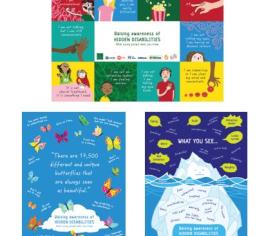
The artwork created by young people has been developed into 3 posters, which will be displayed around Leeds in places such as community hubs and libraries. This will help to spread awareness of the perspective of young people in Leeds with hidden disabilities.
Some of the young people created ‘spoken word’ pieces to express their thoughts and feelings. These have been recorded and can be heard in the following video:
The project was delivered in partnership with Leeds Youth Voice, Child Friendly Leeds, Town Centre Securities PLC and young people from Brighshaw 16+, St John's School, John Jamieson East SILC, Horsforth School and the SEND Youth Council.
More information about the project can be found here.
Raising awareness of disabilities
A video introduction to the project
The artwork
These pieces of artwork are based on the young people’s ideas and use their words.
- Click here to download the educational poster.
- Click here to download the iceberg poster.
- Click here to download the beautiful butterflies poster.
Please download the posters and display in your school, place of work or community.
How to order hard copies of the posters
Complete and return the order form to phrc.forms@leeds.gov.uk, you will need to register here if you haven't already ordered resources from the Public Health Resource Centre.
- P756 Iceberg poster
- P757 Educational poster
- P758 Butterflies poster
Image
Teams backgrounds
We have developed a number of teams backgrounds that can be used during online meetings to promote the Raising Awareness of Disabilities Campaign.
Image

Image

Image

Image

Image

Training slides for staff
Learning sessions around this project have been created by pulling on ideas from the art-work around not making assumptions based on people’s behaviours. For example, by thinking what might be going on for them under the surface.
The training slides encourage staff to consider that disabilities can be ‘hidden’.
Click here to download the training slides for staff.
Assembly pack for schools
The project was used to develop an assembly pack for schools in Leeds to use.
This assembly is based on the ideas pulled from the art-work around not making assumptions based on people’s behaviours. For example, by thinking what might be going on for them under the surface. It also encourages young people to consider that disabilities can be ‘hidden’.
Click here to download the assembly pack.
Information on the disabilities highlighted through the project
The young people who participated in this project, represented a range of special needs and disabilities – they are listed below.
Neurodivergence
- Attention Deficit Hyperactivity Disorder (ADHD)
- Autism
- OCD
- Tourette’s Syndrome
- Epilepsy
- Dyslexia
- Stutter
- Avoidant/Restrictive Food Intake Disorder (ARFID)
- William’s Syndrome
Social, Emotional and Mental Health (SEMH)
- Anxiety
- Depression
- Panic Attack
- Claustrophobia
Sensory disabilities
- Hearing impairment
- Visual impairment
This list includes needs which were represented by the young people who took part in this project, meaning it does not cover all needs/disabilities.
Hidden Disabilities Sunflower
Some disabilities, health conditions, and long-term illnesses cannot be seen by looking at a person. These are sometimes called non-visible disabilities.
Because these conditions are not always obvious, some people may not understand that a person needs support. They may wrongly assume that the person does not have a disability.
The Hidden Disabilities Sunflower is a simple way for a person to show that they may need extra support, understanding, or more time.
A person can choose to wear a Sunflower lanyard if they have a visible or non-visible disability, health condition, or additional support need.
Wearing a Sunflower lanyard does not give automatic priority access, fast-track services, or a place at the front of a queue.
What to expect when wearing a Sunflower lanyard
The Sunflower helps people show that they may need support.
Benefits may include:
- extra support from staff and organisations that recognise the Sunflower.
- more understanding and patience from other people.
- more time to complete tasks or ask for help.
- no need to explain a disability or health condition to everyone.
- the choice to wear the Sunflower whenever support is needed.
- recognition in many places, including shops, schools, colleges, healthcare services, public transport, airports, workplaces, and leisure venues.
- increased confidence when accessing services or travelling independently.
Tips for people who see someone wearing a Sunflower
A Sunflower lanyard does not mean a person wants special treatment. It shows that they may need support, understanding, or extra time.
How to help
- be patient and allow extra time if needed.
- ask, "How can I help?"
- listen carefully to what support the person says they need.
- respect the person's privacy.
- do not ask someone to prove or explain their disability.
- be kind and understanding.
- remember that support needs can change from day to day.
Important things to remember
- not all disabilities can be seen
- the Sunflower is a voluntary symbol
- a person does not have to tell others about their disability to receive support
- every person's needs are different
More information
More information about the Hidden Disabilities Sunflower is available on the Hidden Disabilities Sunflower website: https://hdsunflower.com/uk/